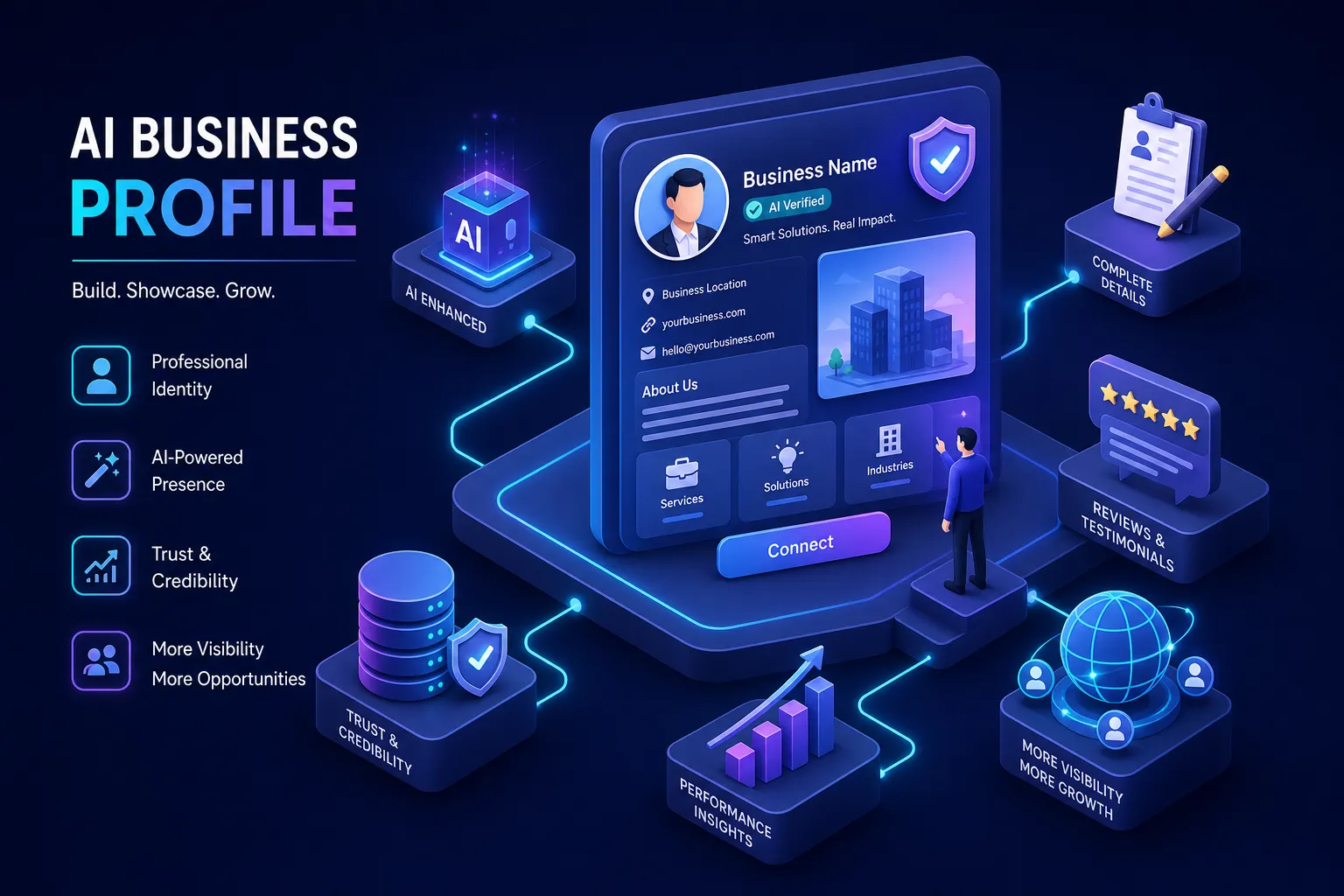
How to Create a Professional AI Business Profile
To build a professional AI-powered business profile, you need a high-quality AI-generated headshot, a company description written with an AI copy tool from structured inputs, and a consistent published presence across LinkedIn, your website, and key directories. Each step builds on the one before it, so skipping any one leaves the profile incomplete. This guide covers all three, with specific tools, templates, and a pre-publish checklist so you finish with a live profile rather than a half-finished draft. Local business owners often cite lack of time and competing priorities as the main reason this process gets pushed aside. A done-for-you setup exists precisely to close that gap.
Key takeaways
Sequence matters: The recommended order is to generate your headshot first, then write your copy, then publish, your photo sets the visual identity that your copy should match.
Photo quality determines output quality: AI tools generally cannot reliably fix severely blurry, low-resolution, or highly inconsistent source photos, high-quality inputs significantly improve results.
Structured inputs produce better copy: Give the AI tool your audience, desired outcome, services, and differentiators before asking for a draft.
Consistency protects credibility: Mismatched names, descriptions, and phone numbers erode trust with both visitors and AI search platforms.
Review before you publish: The business is legally responsible for every statement it publishes, regardless of which tool drafted it.
Visibility requires optimization: A polished profile still needs structured data and optimized listings to appear in AI-generated recommendations.
How to generate a professional AI headshot that actually looks like you
Your profile photo is the first impression a visitor forms, and AI headshot generators have made studio-quality results achievable without a photographer or a half-day shoot. The core process is straightforward: upload a set of source photos, choose a style, and download your output, often in under two hours. The critical variable is the quality and consistency of what you upload.
What your source photos need to look like
The generator's output is only as strong as the photos you feed it. Use images where your face is clear, well-lit, and fully visible from the hairline through the shoulders. Soft daylight or even window light works well; avoid flash, fluorescent overhead lighting, and strong backlighting. Wear solid, neutral-colored clothing such as a plain shirt, blazer, or sweater, and keep your hairstyle, facial hair, and accessories consistent across every photo in the set.
A reliable capture set includes three straight-on shots at neutral, slight smile, and confident smile; two or three slight left-angle shots; and two or three slight right-angle shots. Most tools produce their best results with 8–15 images that prioritize variety over repetition. After generating your results, inspect the full-size output carefully for distorted eyes, unnatural teeth, blurred hair edges, and collar or background inconsistencies before selecting your final image.
Which AI headshot generator should you use
The right tool depends on your situation. According to Designkit (as of 2026), Aragon AI is a strong all-around option for speed and LinkedIn use. According to The AI Rankings, HeadshotPro leads for team standardization and BetterPic is a top choice when 4K or executive portraits matter. ProfilePicture.AI offers the lowest entry price for budget-conscious users, with some trade-off in premium polish.
Create your professional AI business profile: headshots and company copy
The company description is where most business profiles fall flat. AI writing tools, sometimes called AI company profile generators, can produce a polished first draft in minutes, but only when you supply structured, specific inputs. The finished description needs to answer four questions without delay: who you are, what you offer, who you serve, and why someone should trust you.
Start with a master profile template
Before you open any AI tool, fill out a master profile structure covering your company type, target customers, desired outcome, main services, key differentiators, and verifiable proof points. Write a 150- to 250-word master profile first. From that single source, compress a LinkedIn version, a 50-word directory description, and a one-line tagline. This prevents inconsistency across platforms and gives the AI tool something concrete to work with rather than a vague prompt.
Leave out generic claims like "best-in-class," long mission statements with no practical meaning, and any statistics you cannot verify. As a best practice, the opening sentences of every version should state your value proposition directly rather than set a stage or build context, readers and search platforms form their assessment quickly, though longer formats like a full About page may allow slightly more context before the pitch.
Which AI writing tools produce the cleanest results
For initial drafts, ChatGPT and Claude are the strongest starting points. Claude tends to produce more natural prose and follows detailed brand instructions more closely, making it the better choice when your brief includes specific wording restrictions or positioning nuance. ChatGPT handles structured formatting and multiple variants quickly, which is useful when you need several options in one session. Jasper is the right choice when multiple team members need to produce copy that stays on-brand consistently. Use Copy.ai when descriptions support sales or go-to-market workflows, and Anyword when taglines will be tested as advertising copy. These AI branding assets, from headshots to polished copy, come together fastest when you treat the tools as a workflow rather than a one-off task.
Tool | Best choice when | Strength |
|---|---|---|
ChatGPT | You need several structured variants quickly | Flexible tone, strict formatting, rapid output |
Claude | You have detailed brand rules and nuanced positioning | Natural prose, close instruction adherence |
Jasper | Multiple people need consistent branded copy | Brand controls and repeatable team workflows |
Descriptions support sales or go-to-market goals | Sales and marketing-oriented workflows | |
Anyword | Taglines will be tested as advertising copy | Performance-focused variants and optimization |
After generating, run a second prompt asking the tool to remove hype, preserve verified facts, and flag unsupported claims. Never publish AI-generated copy without a human review pass.
Publish your professional AI business profile consistently across every platform
Having polished assets means nothing if the information differs from one platform to the next. Inconsistent names, descriptions, and phone numbers erode trust with both human visitors and search engines evaluating your credibility. Consistency is not just tidiness; it is a signal.
What each platform actually needs from you
LinkedIn rewards keyword-rich, customer-facing descriptions with a clear call to action. According to LinkedIn's own platform guidance, the About section should include the services, locations, industries, and customer types that your prospects actually search for, keep it concise and lead with your value. Your website About page can be warmer and more narrative, but the opening paragraph still needs to state your value proposition clearly rather than tell your founding story. Directory listings should stay concise at 50–75 words, with no long histories and no unverifiable superlatives.
Adapt the master profile you wrote for each format rather than rewriting from scratch. For example, your LinkedIn version might open with a customer-facing one-liner followed by a bulleted list of services, while your directory listing trims that same language to a single tight paragraph. This keeps your language consistent and your core message coherent wherever a potential customer finds you.
Why consistent NAP and copy format matter more than you think
Your business name, address, and phone number must match exactly across your Google Business Profile, LinkedIn page, website, and every directory listing. Inconsistencies confuse visitors who are verifying your business and signal unreliability to AI platforms trying to confirm your credibility. A simple tracking spreadsheet that records your business name as listed, phone format, address format, and description version for each platform prevents the kind of drift that accumulates quietly over months. Review it every time you update any single listing.
What should you review before you publish AI-generated content?
Some teams omit the review step entirely, which increases risk significantly. AI-generated headshots and company copy are commercially usable in many situations, but only after a human review pass and, where appropriate, a disclosure notice placed near the relevant content.
Legal and rights considerations you need to know
Confirm that the AI tool you use permits commercial use before publishing anything. Do not enter confidential employee, customer, or financial data into AI prompts. Verify every factual claim the AI generated, including credentials, years in business, services, and certifications, because AI tools produce plausible-sounding facts that may not be accurate. Avoid using AI-generated images to imply that synthetic offices, employees, or customers are real.
U.S. federal law does not currently require labeling AI-assisted business copy as AI-generated. The legal question is whether the content could mislead a reasonable viewer about identity, authenticity, or a material claim. For profile images, disclosure matters most when a realistic image could be mistaken for an actual employee, customer, or endorser. Note that New York requires conspicuous disclosure in advertisements containing synthetic performers, effective June 9, 2026, so your publishing geography affects your obligations.
The pre-publish checklist
Run through each of these steps before any AI-assisted content goes live:
Confirm commercial-use rights in the tool's terms of service.
Verify every factual claim, credential, date, and statistic in the generated content.
Check for third-party likenesses, logos, or copyrighted material in generated images.
Add a disclosure notice where AI use is material: for example, "AI tools assisted with drafting this profile; [Company] verified and approved the final text."
For realistic AI headshots, include a nearby label such as: "AI-generated image; this is not an actual employee."
Assign a human owner who approves the final profile before it publishes and retains records of the review.
What happens after your profile looks great?
A polished business profile solves the credibility problem. It does not solve the visibility problem. When someone asks ChatGPT, Perplexity, or Google's AI Overviews to recommend a service provider in their area, those platforms pull from structured data, verified listings, and content written in a format AI engines can read and cite. A well-designed profile that is not optimized for that layer stays invisible regardless of how good it looks.
What AI search platforms actually look for
AI search engines evaluate a combination of signals when deciding which businesses to surface: a claimed and fully optimized Google Business Profile, structured schema markup on your website, consistent NAP citations across directories, and FAQ-style content that answers the specific questions your customers type or speak into AI assistants. For example, adding LocalBusiness schema markup to your website's homepage helps AI platforms confirm your name, address, phone number, and category in a machine-readable format, making it easier for those platforms to surface your business confidently. The profile-building steps covered in this article are part of that same foundation. Consistent descriptions and accurate listings across platforms are exactly the signals AI engines use when verifying that a business is real and trustworthy.
When a done-for-you setup makes more sense
For local service businesses, managing the technical side of answer engine optimization, schema setup, Google Business Profile optimization, and lead follow-up automation alongside the profile work described in this article is often too much to maintain alongside running actual operations. That is the problem a full-service local agency is built to solve. Flo Omni handles this as a complete done-for-you system built specifically for local businesses that want to show up in both Google results and AI-generated answers, without managing the technical details themselves. If you are in Montgomery or central Alabama and want your business showing up where your customers are searching, get in touch with our team.
Build the profile, then build the visibility
The process comes down to four steps done in sequence: prepare your source photos carefully, generate a headshot with the right tool for your situation, write your company description using a structured prompt and a human review pass, then publish a consistent profile across every platform your customers use. Run the pre-publish checklist before anything goes live. The businesses showing up in AI-generated recommendations are not necessarily bigger than their competitors, they are more visible because their profiles are structured in the way AI platforms evaluate credibility.
If managing all of it is not realistic alongside running a business, that is exactly what local done-for-you setups exist for. Flo Omni builds and maintains the full system for local businesses in Montgomery and central Alabama, covering everything from web design and local SEO to AEO setup and automated lead follow-up. Reach out to our team to see what a complete, optimized local presence looks like for your business.