
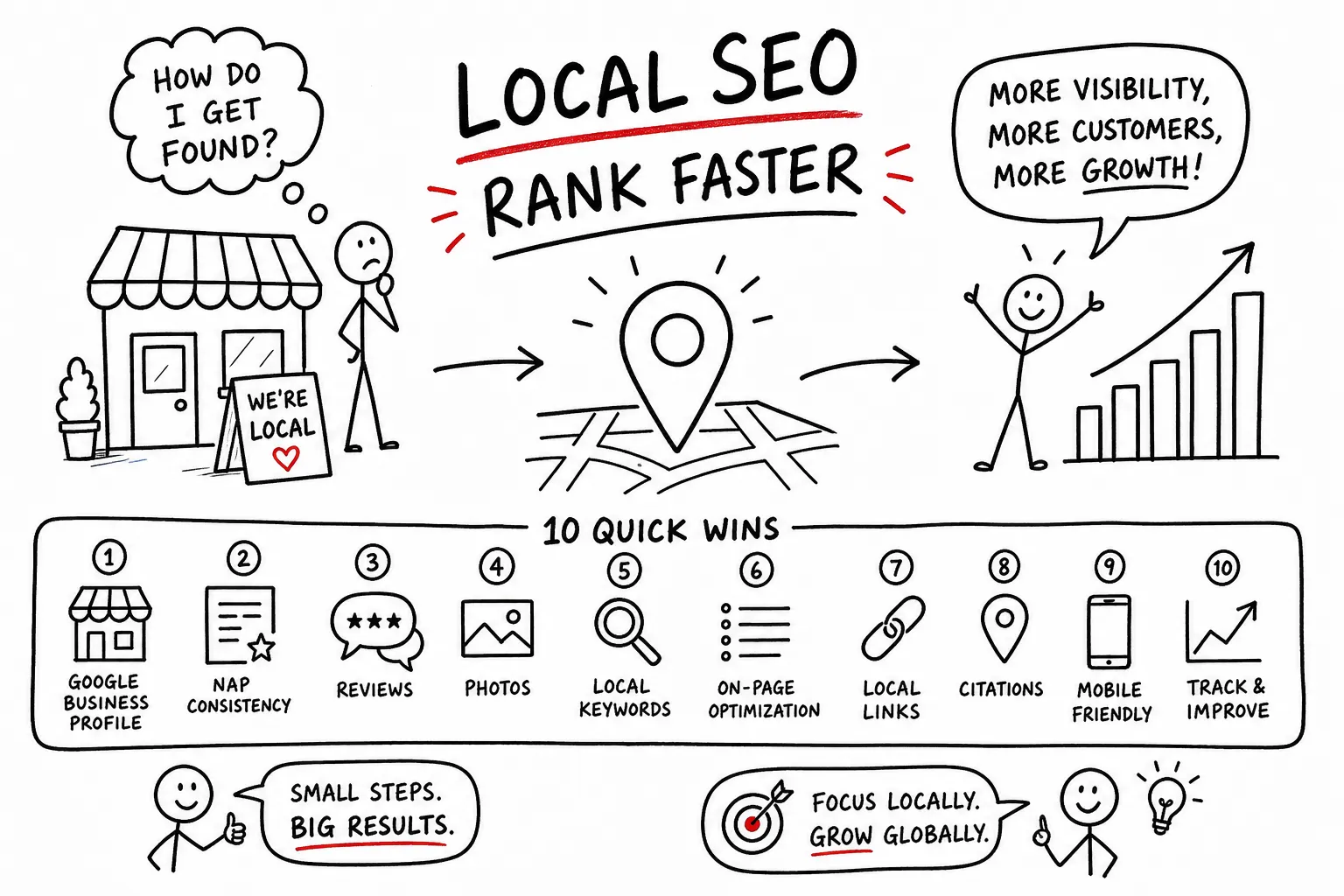
Local SEO for small businesses: 10 quick wins to rank faster
Local SEO for small businesses comes down to five core areas: your Google Business Profile, customer reviews, local citations, your website's on-page signals, and locally relevant authority. Optimizing those five pillars in that order materially improves your likelihood of appearing in relevant local results, though proximity, competition, and other factors also play a role. This guide walks through 10 specific actions ranked by impact, so you can prioritize your time and start seeing movement in the local pack within weeks, not months.
The data backs up that priority order. According to Emulent's 2026 Local SEO Ranking Factors study, Google Business Profile signals account for roughly 32% of local pack ranking, reviews contribute 16–20%, and on-page SEO drives 15–19%. That means the first three sections of this guide alone cover nearly two-thirds of what moves the needle. At Flo Omni, we build systems around these exact pillars for Montgomery-area businesses, connecting the website, the GBP, the review requests, and the follow-up automation inside one platform so nothing falls through the cracks.
Key takeaways
GBP is your foundation: Google Business Profile signals make up roughly 32% of local pack ranking, making it the single highest-leverage place to start.
Reviews compound over time: Businesses in the top three local pack positions averaged 47 reviews compared to 38 for positions 7–10, according to BrightLocal's 2026 Local Consumer Review Survey.
Category choice is critical: Using the wrong primary GBP category can drop your ranking by an average of 9.3 positions for your most important searches.
NAP consistency protects trust: Your business name, address, and phone number must match exactly across every directory, your website, and your GBP.
Results take time: Expect 3–6 months to reach the top three in moderately competitive markets after a full optimization, with early movement possible in 2–4 weeks.
Consistency beats tactics: Regular maintenance typically yields better long-term results than a one-time setup; a weekly, monthly, and quarterly cadence, outlined below, is what 2026 local SEO guides consistently recommend.
What is local SEO and why does your business live or die by it?
The Google local pack is the map plus three business listings that appear above the organic results when someone searches for a service near them. Winning one of those three spots is the goal of local search optimization, and it operates on three factors: relevance, proximity, and prominence. National SEO chases domain authority at scale; local SEO chases those three factors within a defined geographic radius, which is a very different game with very different tactics.
The intent behind local searches is extremely high. Someone searching "plumber in Montgomery" or "HVAC company near me" is not browsing. According to Sagapixel's 2026 local SEO data, about 76% of "near me" searchers visit a business within 24 hours, a signal of high purchase intent that makes local pack placement genuinely valuable for driving calls and visits. The businesses sitting in those spots are not necessarily better than yours. Many of them simply bothered to optimize.
Local SEO small business quick-start: the five pillars
Before diving into each win, it helps to see the full local SEO small business checklist at a glance. The five pillars, Google Business Profile optimization, reviews, local listings and citations, on-page signals, and locally relevant authority, map directly to the 10 wins below. Local keyword research ties each pillar back to the specific search terms your customers actually use, so every action you take is aimed at the right queries. Local search marketing only compounds when these pillars work together; fix one in isolation and the gains are real but limited. Fix all five consistently and the effect is multiplicative.
Wins 1-2: Your Google Business Profile is where you start, not social media
Claim and verify your profile first
The first step is claiming the correct existing listing, not creating a new duplicate. Run a Google search for your business name and address before you do anything else, find any existing profile, and claim it through Google's verification process. Then check for duplicate profiles, which can split your authority and confuse Google about which listing to rank.
Google Business Profile optimization: nail your primary category
Once verified, your primary category becomes the most important single field in the entire profile. Research from OnwardCraft found that a plumbing business using the broad "Contractor" category ranked an average of 9.3 positions lower for "plumber near me" than when it used "Plumber." Switching to the correct, specific category improved average position by 6.8 spots within 21 days. Choose the narrowest accurate category that describes your core service, not a broad one that happens to include a keyword you want.
A complete profile means every field, not just the obvious ones. Fill in your hours including holiday hours, service area, individual services with descriptions and price ranges, attributes like payment options and accessibility features, and your business description. Upload authentic photos of your exterior, team, and completed work on a regular basis. Keep the Q&A section monitored and answer every question yourself so inaccurate community guesses don't sit publicly attached to your business.
Wins 3-4: Building a review system that runs without you
When to ask for reviews
The simplest review system works like this: ask every eligible customer at the right moment, make the request one click, and respond to everything that comes in. The right moment is immediately after a completed job or successful service interaction. Send a direct text or email with the GBP review link, not your homepage. Use the customer's name and keep the message short.
Ask every qualifying customer using the same rule, not just the ones you expect will be happy. Selectively soliciting only satisfied customers is review-gating, and it violates Google's policies. The goal is a consistent stream of honest feedback over time, because review recency matters alongside total count. Platforms like Flo Omni trigger a review request text automatically after a job is marked complete, which eliminates the "I forgot to ask" problem without adding a separate tool or manual step to your day.
How to respond to negative reviews
When a negative review comes in, respond within 24–48 hours using this five-part structure: acknowledge the feedback, apologize for the experience, address the specific issue without arguing, explain what the next step is, and invite the customer to contact you privately. What you want to avoid is defending your business point-by-point in public, using a copy-paste response that ignores what actually happened, or blaming the customer. Every response is public, and future customers read them as signals of how you operate.
Wins 5-6: Local citations and on-page signals that reinforce trust
Core citation sources for home service businesses
Start with what Emulent calls the core four: Google Business Profile, Bing Places, Apple Maps, and Yelp. Claim all of them before moving on. For home service businesses, add your state licensing board listing, relevant trade association directories like PHCC for plumbers or ACCA for HVAC companies, and any manufacturer-authorized dealer pages for brands you're certified to install. These carry more credibility than generic "best contractor" directories because they verify your legal authorization to operate.
The rule across every local listing and citation is exact NAP consistency: the same business name spelling, the same address format, the same phone number. A single inconsistency, like "St." on one listing and "Street" on another, signals confusion to Google about whether these are the same business. Search your business name and address periodically to find duplicates or outdated listings and correct them directly.
Local keyword research: how to choose city + service terms
Your website needs to reinforce what your GBP says, not contradict it. Sound local keyword research starts with pairing your core service with your city and surrounding service areas: "HVAC repair Montgomery," "plumber Prattville," and similar combinations. Each major service deserves its own dedicated page with the city name and service in the page title, the H1, and naturally throughout the content. Add LocalBusiness schema markup in JSON-LD format, using the most specific subtype available for your business type, such as "Plumber" or "HVACContractor" rather than the generic "LocalBusiness." Include your NAP on the website exactly as it appears on your GBP, with click-to-call contact information prominent on mobile.
Wins 7-8: Local authority through backlinks and community presence
Local backlinks follow a clear priority order. Start with relationships you already have. If you're a certified installer or authorized dealer for any manufacturer, ask to be added to their dealer locator page; manufacturer directories frequently include a website link, though it's worth verifying on a case-by-case basis before counting on it. Chamber of commerce membership typically includes a directory listing. Professional association profiles frequently do too. These are links from real, trusted organizations that Google already knows and respects.
Beyond existing relationships, look for unlinked mentions of your business in local news, event pages, or community sites. A polite email to the publisher asking them to turn the mention into a link is all it takes, and these links are free. Sponsoring a local nonprofit, school team, or community event often results in a linked sponsor page, but confirm that before committing. Write genuine testimonials for tools and vendors you actually use; many companies publish customer testimonials with a company link back to the reviewer's site. That content can also serve your local search marketing efforts by keeping your brand visible across relevant community channels.
A small number of high-quality, locally relevant links from real organizations generally outperforms a large volume of low-quality directory submissions, quality and local relevance matter far more than raw count. Local case studies featuring real projects (with customer permission) attract natural links and show up in local search results on their own.
Wins 9-10: Tracking progress and keeping your local SEO momentum
GBP Insights gives you the most direct window into local performance: calls, website clicks, direction requests, and photo views. Track these month over month, not week over week, because the signal-to-noise ratio over short periods is too low to be useful. For rank tracking, use a tool set to your city rather than your home IP address, because local results vary dramatically by searcher location.
The maintenance rhythm is straightforward. Weekly: respond to new reviews, check for suggested edits on your GBP, and add one real photo when you have something worth sharing. Monthly: review your GBP metrics, request reviews from recent customers, and verify your hours and services are still accurate. Quarterly: audit your citations for consistency, reassess your GBP categories and attributes, update seasonal hours, and compare your profile against the top-ranked local competitors for your main services. The table below maps each cadence to the task and why it matters.
Cadence | Task | Why it matters |
|---|---|---|
Weekly | Respond to new reviews; check suggested GBP edits; add a photo | Review recency and profile activity are ongoing ranking signals |
Monthly | Review GBP metrics; request reviews from recent customers; verify hours and services | Keeps profile accurate and review velocity steady |
Quarterly | Audit citations for NAP consistency; reassess categories; update seasonal hours; compare competitors | Prevents drift in citation data and keeps the profile competitive |
Local SEO compounds when you stay consistent. The businesses that drift back down the rankings are often the ones that optimized once and walked away. Treat the monthly rhythm as a system, not a project, and the gains you earn in months three through six continue building through month twelve.
Start with the fundamentals and stay consistent
The five pillars of local search success are your Google Business Profile, customer reviews, local citations, website on-page signals, and locally relevant authority. The businesses winning in the local pack aren't doing anything exotic. They verified their GBP, chose the right primary category, built a review habit, cleaned up their local listings and citations, and made sure their website matches what Google expects.
The difference between businesses that rank and those that don't isn't secret tactics, it's execution consistency. A complete GBP with the right category and steady reviews often outperforms a technically strong website with a neglected profile, because GBP signals carry heavy weight in local pack rankings according to 2026 ranking-factor studies (Emulent). Expect early movement in 2–4 weeks after a full optimization, with meaningful local pack gains in 3–6 months in most moderately competitive markets.
If you'd rather have the review requests, missed-call follow-up, citation management, and local SEO infrastructure running from one place without juggling five different tools, that's exactly what we built Flo Omni to handle. Reach out to our team and we can walk you through what a full local search setup looks like for your specific business and market.
Frequently Asked Questions
Are duplicate Google Business Profile listings harmful and what should we do about them?
Yes, duplicate profiles can split your authority and confuse Google, so you should find any existing listing and claim the correct one before creating anything new. Run a search for your business name and address, claim the verified profile, and remove or merge duplicates to protect your ranking signals.
Can we automate review requests without breaking Google's rules?
Yes, you can automate review requests as long as you ask every eligible customer using the same rule and avoid selective solicitation of only satisfied customers. Triggering a review request automatically after a job is marked complete and sending the direct GBP review link ensures a consistent stream of honest feedback without review-gating.
How important are local backlinks compared to submitting to many directories?
A small number of high-quality, locally relevant links from trusted organizations generally outperforms a large volume of low-quality directory submissions. Start with existing relationships like manufacturer dealer pages, chambers of commerce, and professional associations, and pursue local news mentions or sponsor links where appropriate.